How do tornadoes form?
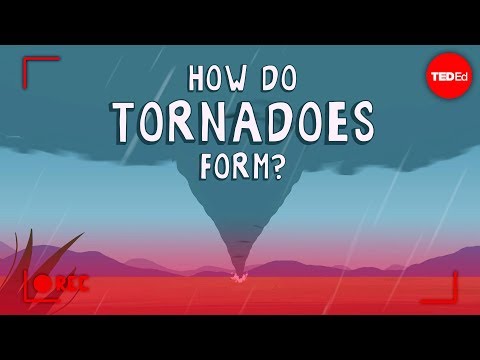
Transkrip & Terjemahan
They call me the tornado chaser.
Mereka memanggilku pemburu tornado.
When the wind is up and conditions are right, I get in my car and follow violent storms.
Saat angin kencang dan kondisinya pas, aku masuk mobil dan mengejar badai dahsyat.
“Crazy,” you say?
Mungkin kamu bilang, Kamu gila.”
Perhaps, but really I chase these sky beasts to learn about them.
Mungkin saja, tapi sebenarnya aku mengejar “monster langit” ini untuk mempelajarinya.
I want to share with you what I know.
Aku ingin berbagi denganmu apa yang sudah aku pelajari.
Tornadoes are rapidly rotating columns of air that form inside storms that connect with the ground via a funnel of cloud.
Tornado adalah kolom udara yang berputar sangat cepat, terbentuk di dalam badai, dan terhubung ke tanah lewat corong awan.
When that happens, they tear across the Earth, posing a huge threat to life and property.
Saat itu terjadi, mereka menyapu permukaan bumi dan jadi ancaman besar bagi nyawa serta harta benda.
Because of this, there's a great deal of research into these phenomena, but the truth is, there's still a lot we don't know about how tornadoes form.
Karena itulah banyak penelitian dilakukan, tapi kenyataannya masih banyak hal yang belum kita pahami tentang bagaimana tornado terbentuk.
The conditions that may give rise to one tornado won't necessarily cause another.
Kondisi yang memicu satu tornado belum tentu memicu tornado lainnya.
But we have learned a lot since people first started recording tornadoes, like how to recognize the signs when one is brewing in the sky.
Tapi sejak orang mulai mencatat kejadian tornado, kita sudah belajar banyak, termasuk cara mengenali tanda-tanda saat tornado mulai “dimasak” di langit.
Are you coming along for the ride?
Mau ikut perjalanan ini?
Tornadoes begin with a thunderstorm but not just any thunderstorm.
Tornado berawal dari badai petir, tapi bukan sembarang badai.
These are especially powerful, towering thunderstorms called supercells.
Ini adalah badai petir raksasa dan sangat kuat yang disebut supercell.
Reaching up to over 50,000 feet, they bring high force winds, giant hailstones, sometimes flooding, and great flashes of lightning, too.
Tingginya bisa lebih dari 50.000 kaki, membawa angin super kencang, hujan es besar, kadang banjir, dan kilat yang menyambar-nyambar.
These are the kinds of storms that breed tornadoes, but only if there are also very specific conditions in place, clues that we can measure and look out for when we're trying to forecast a storm.
Badai seperti inilah yang bisa melahirkan tornado, tapi hanya jika ada kondisi khusus yang terpenuhi—tanda-tanda yang bisa kita ukur dan pantau saat memprediksi cuaca.
Rising air is the first ingredient needed for a tornado to develop.
Udara yang naik adalah bahan pertama yang dibutuhkan agar tornado bisa terbentuk.
Any storm is formed when condensation occurs, the byproducts of the clouds.
Badai terbentuk saat terjadi kondensasi, proses yang membentuk awan.
Condensation releases heat, and heat becomes the energy that drives huge upward drafts of air.
Kondensasi melepaskan panas, dan panas itulah yang jadi energi pendorong arus udara ke atas.
The more condensation and the bigger the storm clouds grow, the more powerful those updrafts become.
Semakin banyak kondensasi dan semakin besar awannya, semakin kuat pula arus naiknya.
In supercells, this rising airmass is particularly strong.
Di supercell, massa udara yang naik ini jauh lebih kuat.
As the air climbs, it can change direction and start to move more quickly.
Saat udara naik, arahnya bisa berubah dan kecepatannya bertambah.
Finally, at the storm's base, if there is a lot of moisture, a huge cloud base develops, giving the tornado something to feed off later, if it gets that far.
Akhirnya, di dasar badai, kalau kelembapannya tinggi, terbentuk dasar awan besar yang nantinya bisa “jadi bahan bakar” tornado, kalau prosesnya sampai sejauh itu.
When all these things are in place, a vortex can develop enclosed by the storm, forming a wide, tall tube of spinning air that then gets pulled upwards.
Kalau semua unsur ini terpenuhi, pusaran bisa terbentuk di dalam badai, menciptakan tabung udara tinggi dan lebar yang berputar lalu tersedot ke atas.
We call this a mesocyclone.
Ini disebut mesosiklon.
Outside, cool, dry, sinking air starts to wrap around the back of this mesocyclone, forming what’s known as a rear flank downdraft.
Di luar, udara dingin dan kering yang turun mulai melilit bagian belakang mesosiklon, membentuk yang disebut rear flank downdraft.
This unusual scenario creates a stark temperature difference between the air inside the mesocyclone, and the air outside, building up a level of instability that allows a tornado to thrive.
Situasi unik ini menciptakan perbedaan suhu yang tajam antara udara di dalam dan di luar mesosiklon, menimbulkan ketidakstabilan yang memungkinkan tornado tumbuh.
Then, the mesocyclone's lower part becomes tighter, increasing the speed of the wind.
Lalu bagian bawah mesosiklon menyempit, membuat kecepatan anginnya meningkat.
If, and that's a big if, this funnel of air moves down into that large, moist cloud base at the bottom of the parent storm, it sucks it in and turns it into a rotating wall of cloud, forming a link between the storm that created it and the Earth.
Kalau—dan ini “kalau” yang besar—corong udara itu turun ke dasar awan lembap tadi, ia akan menyedotnya dan mengubahnya jadi dinding awan berputar yang menghubungkan badai dengan bumi.
The second that tube of spinning cloud touches the ground, it becomes a tornado.
Begitu tabung awan berputar itu menyentuh tanah, saat itulah ia resmi jadi tornado.
Most are small and short-lived, producing winds of 65–110 miles per hour, but others can last for over an hour, producing 200 mile per hour winds.
Sebagian besar ukurannya kecil dan berlangsung singkat, dengan kecepatan angin 65–110 mil per jam, tapi ada juga yang bisa bertahan lebih dari satu jam dengan kecepatan 200 mil per jam.
They are beautiful but terrifying, especially if you or your town is in its path.
Mereka indah sekaligus menakutkan, apalagi kalau kamu atau kotamu berada di jalurnya.
In that case, no one, not even tornado chasers like me, enjoy watching things unfold.
Dalam situasi seperti itu, tak seorang pun—bahkan pemburu tornado sepertiku—menikmati melihatnya terjadi.
Just like everything, however, tornadoes do come to an end.
Seperti hal lain, tornado pun akhirnya berakhir.
When the temperature difference disappears and conditions grow more stable, or the moisture in the air dries up, the once fierce parent storm loses momentum and draws its tornado back inside.
Saat perbedaan suhu menghilang dan kondisi jadi lebih stabil, atau kelembapan udara mengering, badai induknya kehilangan tenaga dan “menarik kembali” tornadonya.
Even so, meteorologists and storm chasers like me will remain on the lookout, watching, always watching to see if the storm releases its long rope again.
Meski begitu, ahli meteorologi dan pemburu badai sepertiku akan tetap siaga, terus mengamati, selalu waspada kalau-kalau badai itu kembali melepaskan “tali panjangnya” lagi.
Vocabulary List
chaser (noun) = pemburu
violent (adjective) = dahsyat; ganas
funnel (noun) = corong
tear across (phrasal verb) = menyapu dengan cepat; melintas dengan ganas
pose (verb) = menimbulkan; menyebabkan
threat (noun) = ancaman
property (noun) = harta benda; properti
give rise (to) (phrasal verb) = menimbulkan; memicu
necessarily (adverb) = secara pasti; belum tentu (dalam kalimat negatif)
recognize (verb) = mengenali
brew (verb) = terbentuk; mulai berkembang (tentang badai)
towering (adjective) = menjulang tinggi
hailstone (noun) = butiran hujan es
flooding (noun/gerund) = banjir
lightning (noun) = kilat; petir
breed (verb) = menghasilkan; melahirkan
clue (noun) = petunjuk
look out for (phrasal verb) = mengawasi; mewaspadai
forecast (verb) = meramalkan; memprediksi
ingredient (noun) = bahan; unsur
byproduct (noun) = produk sampingan; hasil sampingan
drive (verb) = mendorong; menggerakkan
particularly (adverb) = terutama; secara khusus
moisture (noun) = kelembapan
feed off (phrasal verb) = mengambil energi dari; memanfaatkan
enclosed (adjective/past participle) = tertutup; terkurung
tube (noun) = tabung
spin (verb) = berputar
sink (verb) = tenggelam; turun
stark (adjective) = mencolok; kontras tajam
thrive (verb) = berkembang pesat; tumbuh dengan baik
short-lived (adjective) = berumur pendek; berlangsung singkat
last (verb) = berlangsung
unfold (verb) = terjadi; terungkap
lookout (noun) = pengawasan; posisi siaga